Running your villa AC on solar
Air conditioning is the reason your summer bill looks the way it does. Running it on solar is a specific setup — a 5 kWp or 7 kWp array with battery storage — because cooling does not stop when the sun goes down.
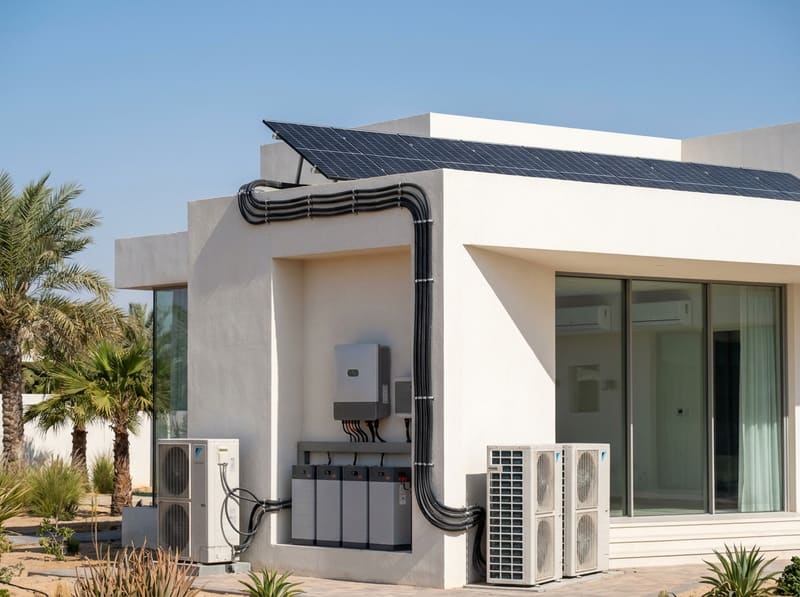
- 5 kWpSmaller villa, with battery
- 7 kWpMore splits, with battery
- Battery includedNot an optional extra
- Surge ratedFor compressor start
These two sizes cover almost every villa AC job we do. A 5 kWp system with panels, inverter and lithium battery runs approximately AED 13,000–18,000 installed, and 7 kWp approximately AED 18,000–25,000. Which one you need comes from how many indoor units run and for how long — and for a confirmed price, WhatsApp or call us.
Panels for the day, battery for the evening
Cooling a villa is not a daytime-only load. The compressors work hardest through the afternoon, which suits a rooftop array perfectly — but the hours a family actually feels the heat are the evening and the night, when the array has stopped. That is the whole reason a villa AC system is panels and storage, not panels alone.
The two sizes we install
- 5 kWp with battery — a smaller villa, or two to three splits running through the day and into the evening
- 7 kWp with battery — more indoor units, or cooling that has to hold through most of the night
- Both sit inside our 1–10 kWp range, and both are quoted as one system: array, inverter, battery and mounting
Why the battery is not optional here
Without storage you offset only the daytime half of your cooling, and the evening — when everyone is home and the bedrooms need to be cold — still comes off the meter at full rate. Storage is what turns a solar system from a daytime discount into something that actually changes how the villa runs.
Start with the plate, not the tonnage
Tonnage tells you cooling capacity, not electricity. A modern inverter split draws considerably less than an older non-inverter unit of the same tonnage, and that difference is often what decides whether you need the 5 kWp or the 7 kWp system. So we read the plate on your units and ask how many hours each one really runs.
The inverter has to handle the start, not just the run
A compressor draws a large surge for a moment when it kicks in, far above its running figure. Equipment sized only for the running load will trip or, worse, sag and stress the compressor. We specify pure sine wave equipment with real surge headroom — one of the places cheap quotes quietly cut corners.
What we check on the roof
Shading from water tanks, the majlis extension and neighbouring walls, the cable run from the array to where the inverter and battery can sit in shade, and whether the roof suits ballasted or bolted mounting. All of it changes the real output, and none of it can be judged from a satellite photo.
Villa AC and solar — questions
What size solar system do I need to run villa AC?
Do I really need a battery for AC?
Can solar run my AC at night?
Will solar run my AC during a power cut?
Is an inverter AC better for solar?
Related pages
- Rooftop solar for UAE villas
- Off-grid solar for azba and camel farms
- Solar water pumps for farms and azba
- Battery storage, sized on your night load
- Solar panel cleaning and maintenance
- Running AC on an azba, off the grid
- What solar actually costs in the UAE
- Hybrid solar systems in the UAE
- Off-grid solar system prices in the UAE
- Is solar worth it in the UAE?
- Solar yard and street lights for farms
- Solar for worker rooms and staff accommodation
- Book a free site visit
- Solar panel installation in Sharjah
- Solar panel installation in Ajman
- Solar panel installation in Umm Al Quwain
- Solar panel installation in Dubai
- Solar panel installation in Ras Al Khaimah
Send a location pin. We'll come and measure.
Anywhere in the five emirates, at no cost and with no obligation. You get an itemised fixed-price quote — and an honest answer if solar is the wrong fit.